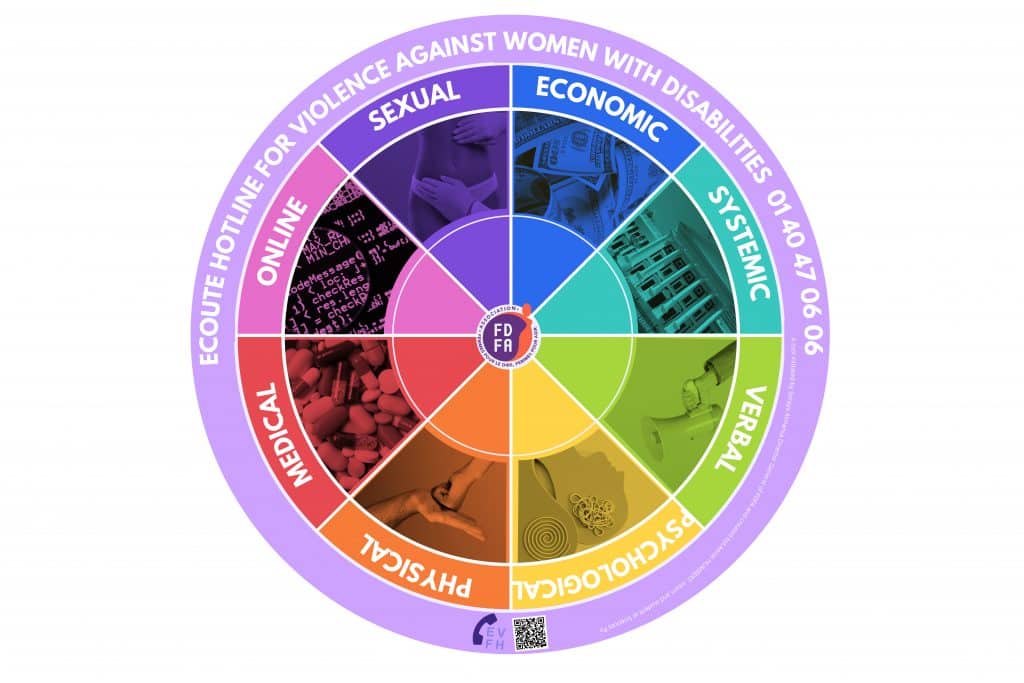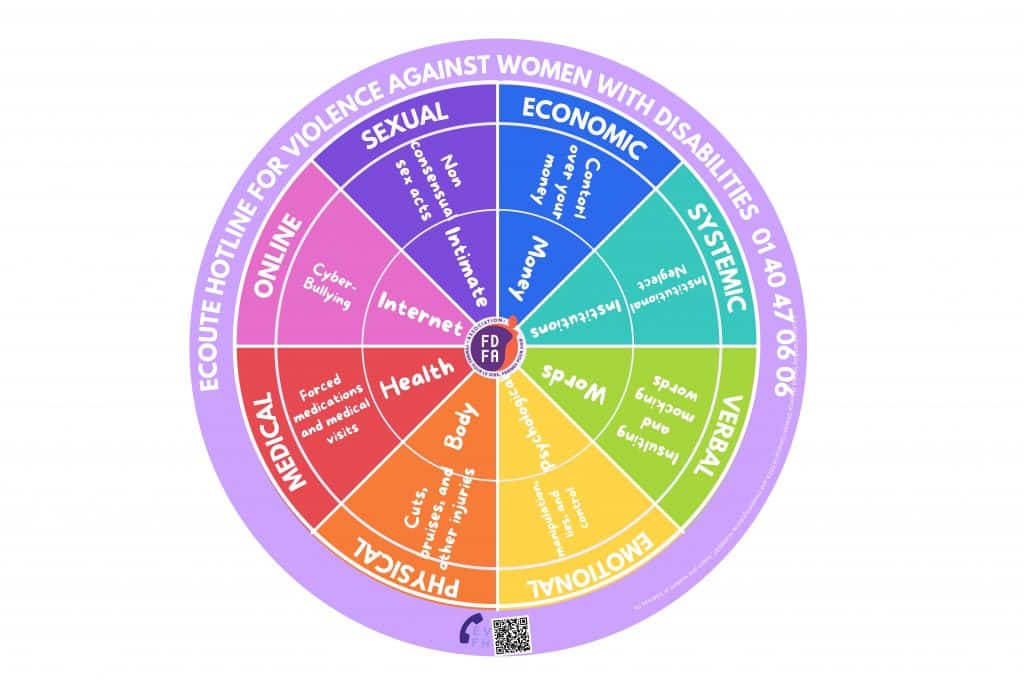
The Wheel of Violence is an educational and awareness-raising tool initiated and supervised within FDFA by Soraya Almansa, Executive Director, and developed by Léonie Humbert, a student at Sciences Po Paris and an intern at FDFA.
It provides a comprehensive visual overview of the many forms of violence that women with disabilities may experience throughout their lives.
The Wheel is based on a simple yet essential observation: violence is not limited to physical abuse. It can also be psychological, sexual, economic, administrative, institutional, medical, or digital, and these forms of violence often overlap and reinforce one another.
The Wheel of Violence makes the invisible visible.
What is the Wheel of Violence for?
The Wheel helps to :
- identify forms of violence that often remain unnamed or unrecognised;
- provide a clear and accessible overview of the different types of abuse;
- demonstrate how multiple forms of violence can intersect and accumulate;
- raise awareness among women with disabilities, their families, caregivers, and professionals;
- facilitate discussion during counselling sessions, workshops, and support groups;
- support health, social care, and disability services in their violence prevention work.
A tool tailored to the realities of disability
The Wheel of Violence takes into account situations that are specific to women with disabilities, including :
- dependency on a caregiver, partner, family member, or professional ;
- confiscation or restriction of assistive devices ;
- infantilisation and denial of autonomy ;
- refusal to provide reasonable accommodations ;
- institutional violence ;
- lack of informed consent in healthcare settings ;
- increased social isolation and exclusion.
These realities are too often absent from mainstream violence prevention tools, making the Wheel of Violence a unique resource in France.
Who is it for ?
The Wheel of Violence is intended for :
- women with disabilities, to help them recognise and understand the violence they may experience ;
- helpline workers, psychologists, lawyers, social workers, and support professionals ;
- healthcare, social care, and disability service professionals ;
- organisations working to prevent domestic, intimate partner, and family violence ;
- trainers and educators specialising in equality, gender, disability, and violence prevention.
The Wheel of Violence is a practical, accessible, and evidence-based resource that strengthens awareness, prevention, and support for women with disabilities facing violence.